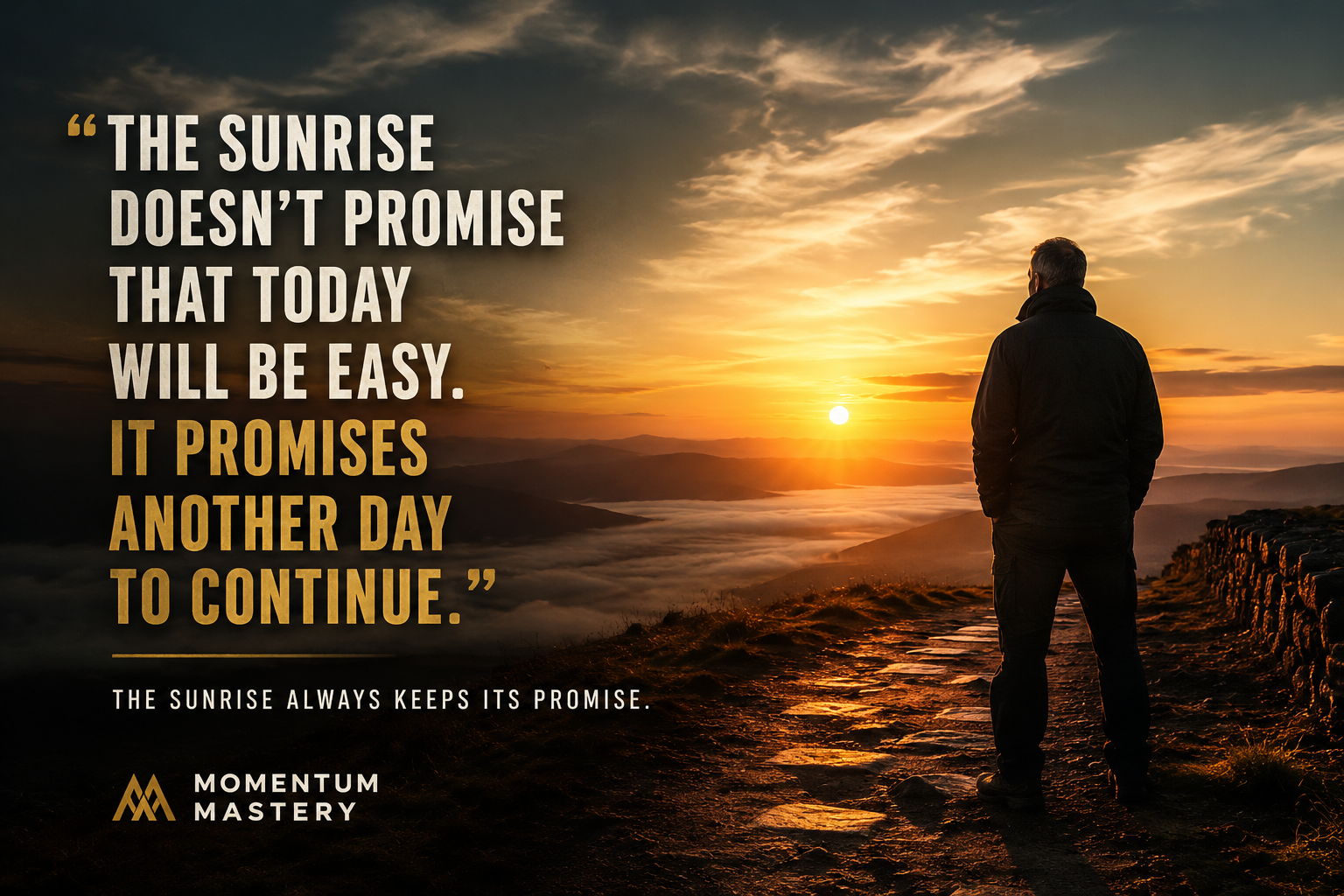
The Sunrise Always Keeps Its Promise
For a good part of my life, I didn’t realize how many decisions I was making because of fear.
Fear of failing. Fear of being rejected.
Sometimes, strangely enough, even fear of succeeding, because success creates expectations of its own. Once you’ve accomplished something, there’s suddenly something to maintain, something to live up to, and something you could lose.
The interesting thing about fear is that it doesn’t always announce itself.
Sometimes it calls itself caution. Sometimes it sounds like patience.
Sometimes it tells you that you’re simply being sensible, waiting for better circumstances, gathering more information, or choosing the safer path.
Looking back, I can see periods of my life when I thought I was making careful decisions when what I was really doing was trying not to get hurt.
I’ve learned something since then. You don’t become resilient by arranging your life so nothing can hurt you.
You become resilient by living long enough to discover that when life does hurt you, you can handle it.
My parents were good people. They loved me, wanted the best for me, and taught me what they knew.
Work hard. Do the right thing. Treat people properly. Stay out of trouble.
Behind those lessons was an understandable hope: if you behaved well and did what you were supposed to do, perhaps life would treat you reasonably well in return.
There was nothing wrong with that map. It simply wasn’t complete.
Life eventually filled in the missing pieces.
You can work hard and still watch a deal collapse. You can trust someone and be disappointed. You can carefully calculate a risk and discover that you calculated incorrectly. You can do the right thing and still lose.
You can love someone and lose them. You can wake up knowing exactly how the day is supposed to go and climb into bed that night thinking, What the hell happened?
Life never agreed to protect us from uncertainty.
Once you’ve been knocked around enough, however, it’s natural to begin protecting yourself.
You remember what hurt. You remember the rejection. You remember the failure.
And without necessarily realizing what you’re doing, you begin organizing your decisions around making sure those things don’t happen again.
You don’t ask because somebody might say no. You don’t try because you might fail. You don’t change because the familiar problem seems less frightening than the unfamiliar possibility.
You don’t begin because you aren’t certain you can finish.
Eventually, avoiding pain can become a way of life. And that’s the trap.
Because if avoiding failure becomes your highest priority, you’ll inevitably begin avoiding some of the experiences that might have helped you grow.
I’ve done that.
What changed wasn’t that I somehow became fearless. I don’t think that’s a realistic expectation for human beings.
What changed was my understanding of fear.
Fear was still entitled to an opinion. It just wasn’t entitled to make the decision.
As the years accumulate, something else begins to happen. You accumulate evidence. You’ve been disappointed before.
And you’re still here. You’ve failed before. Still here.
You’ve made mistakes, lost things you wanted to keep, faced problems you didn’t know how to solve, and lived through days you would never willingly choose to experience again.
Still here.
Eventually that evidence starts to matter more than the fear.
Resilience isn’t the conviction that bad things won’t happen.
Resilience is the confidence that when they do, you’ll find a way to deal with them.
Perhaps not immediately. Perhaps not perfectly.
Perhaps you’ll need someone else’s help. Perhaps the solution will require abandoning your original plan altogether.
But you’ll deal with it.
And once you understand that, fear begins to lose some of its authority.
It can come along for the ride. It just doesn’t get to drive.
That brings me to one of the most important ideas behind Momentum Mastery:
Never return to zero.
We’re remarkably good at allowing temporary events to become judgments about who we are.
One terrible day becomes, I’m failing.
A week in which we lose our routine becomes, I’ve lost my momentum.
A setback becomes, Here I go again.
Then we make the bigger mistake: we mentally discard everything that happened before the setback.
But progress doesn’t work that way.
One bad day doesn’t erase a hundred good ones. One mistake doesn’t remove everything the mistake taught you. One failure doesn’t transform you back into the person you were before you tried.
You’re not starting again from zero.
You’re continuing from experience.
That distinction matters.
It’s also why I like thinking about momentum as elastic.
Momentum can stretch.
It can bend.
It can slow almost to nothing.
Life can pull it in directions you never anticipated.
But that doesn’t mean everything you’ve built has disappeared.
If you’ve spent months becoming someone who takes action, one procrastinating day doesn’t erase that identity.
If you’ve been developing discipline, one lapse doesn’t eliminate it.
If you’ve built a business and something fails, you haven’t magically returned to the day before you started. You’re standing in a different place now because you know things you didn’t know then.
So don’t judge your entire direction from today’s snapshot.
Trust the Trend.
Zoom out far enough to see what is actually happening.
Who are you becoming?
What have you learned?
Which direction are you moving?
Then continue.
There was another change that came with understanding this.
Fear tends to make us think about protection.
What could go wrong?
What could I lose?
What if I’m rejected?
What if this doesn’t work?
Those can be legitimate questions. There are times when they need to be asked.
The problem begins when they’re the only questions we’re asking.
There is another question that has served me much better:
How can I be useful today?
What problem can I solve? Who can I help? What can I create? Where can I add value?
None of that requires pretending we live in a world of magical unlimited abundance.
We don’t.
Resources can be limited. Circumstances can be difficult. Competition exists. Timing matters. Opportunities can disappear.
But problems continue to need solutions.
And wherever someone has a problem, there is an opportunity for someone else to be useful.
That’s an important shift.
Instead of spending all of your energy wondering what you need to protect, you begin thinking about what you have to contribute.
Fear turns your attention inward.
Service turns it outward.
And sometimes the best thing you can do when you’ve become trapped inside your own worries is to help somebody else move forward.
Which brings me back to the sunrise.
Every morning, it happens again.
The sun rises regardless of what happened yesterday.
It doesn’t rise because yesterday went well.
It doesn’t rise because you deserved another chance.
And it certainly doesn’t guarantee that today will be easier.
It just rises.
For a long time, people have used the new day as a metaphor for a clean slate. I understand why, but I think about it differently now.
I don’t want yesterday erased.
Yesterday contains things I need.
It contains lessons.
Experience.
Mistakes I don’t need to repeat.
Small victories nobody else saw.
Strength I didn’t know I possessed.
Even the scars have information in them.
So when tomorrow’s sun comes up, I won’t be starting over.
I’ll be bringing yesterday with me.
The sunrise doesn’t promise that today will be easy.
It promises another day to continue.
Maybe that’s all the promise we need.
You don’t have to fix your entire life tomorrow morning.
You don’t have to conquer every fear.
You don’t have to compensate for everything that went wrong yesterday.
And you certainly don’t have to wake up filled with some extraordinary burst of motivation and reinvent yourself before breakfast.
Get up.
See where you are.
Remember where you’re headed.
Do something useful.
Take another step.
And when tomorrow arrives, do it again.
That’s how resilience develops.
That’s how identity changes.
That’s how fear gradually loses its ability to control your choices.
And eventually, momentum becomes more than a string of productive days.
It becomes the way you live.
Never return to zero.
The sunrise always keeps its promise.