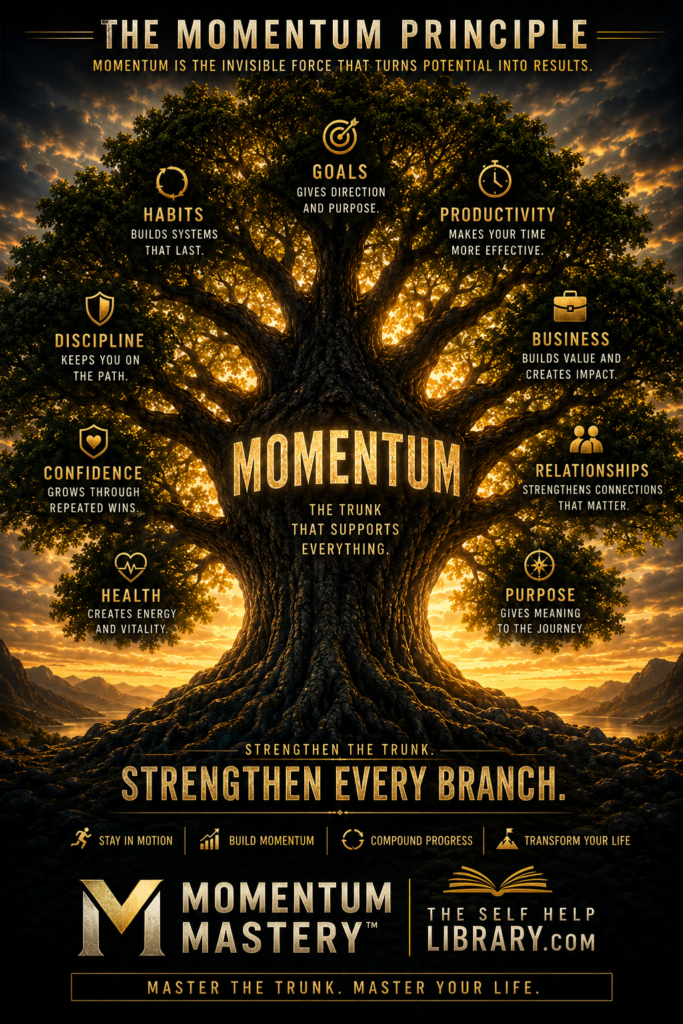
The Momentum Principle
Why Momentum May Be the Hidden Force Behind Every Success Story
A few years ago, if someone had asked me what the most important success principle was, I probably would have given one of the usual answers. Discipline. Consistency. Habits. Goal setting. Mindset. Purpose.
In fact the old TSHL website had over 6000 of the old articles and posts. I’ve spent decades studying them.
I’ve read the books. Filled notebooks with ideas. Attended seminars. Tested systems. Built businesses. Started over more times than I care to admit.
And somewhere along the way, I noticed something interesting.
The people who succeeded weren’t always the smartest.
They weren’t always the most talented.
They didn’t always have the best plan.
But they almost always had one thing in common.
They stayed in motion long enough for results to compound.
The entrepreneur who built the successful company kept showing up after the excitement wore off.
The athlete kept training when progress slowed down.
The writer kept writing when nobody was reading.
The investor kept investing through good markets and bad.
The person who transformed their health kept making small decisions long after the initial motivation disappeared.
Different goals.
Different paths.
Different lives.
But the same underlying force.
Momentum.
The more I looked for it, the more I saw it everywhere.
It was hiding beneath habits.
It was hiding beneath discipline.
It was hiding beneath confidence.
It was hiding beneath productivity.
Eventually, I began asking a different question.
What if momentum isn’t just another success principle?
What if momentum is the force that makes the other principles work?
That question eventually led me to a simple image I couldn’t stop thinking about.
A tree. (And then, I stripped the old website down to bare bones, and started building Momentum Mastery.)
The Tree That Changed Everything
Imagine standing in front of a massive ancient tree.
The branches stretch in every direction. Some reach toward the sky. Others spread wide and strong. Every branch is different.
But they all share one thing in common. They are connected to the same trunk.
Now imagine that each branch represents a major area of personal growth.
One branch is habits.
Another is discipline.
Another is confidence.
Another is health.
Another is productivity.
Another is business.
Another is purpose.
Another is relationships.
At first glance, each branch appears independent.
Most self-help advice focuses on strengthening one branch at a time.
Improve your habits.
Build more discipline.
Increase productivity.
Find your purpose.
Develop confidence.
Those are all worthwhile pursuits.
But what if we’re looking in the wrong place? What if the real source of strength isn’t the branches?
What if it’s the trunk?
The Trunk Supports Every Branch
The trunk of the tree is momentum. Everything else grows from it.
Think about habits.
A habit isn’t built because you perform an action once. It’s built because you continue performing that action long enough for it to become automatic.
That’s momentum.
Think about confidence. Confidence rarely appears before action. Most confidence is earned. It develops through repeated experiences, repeated effort, repeated follow-through.
That’s momentum.
Think about discipline. People often treat discipline like a personality trait. But much of what we call discipline is simply the result of staying in motion.
The first workout requires effort. The fiftieth workout feels normal.
The first article feels difficult. The hundredth article becomes part of your identity.
Momentum reduces resistance.
Momentum turns effort into routine.
Momentum creates discipline.
The same pattern appears everywhere.
Productivity.
Health.
Business.
Relationships.
Purpose.
Different branches. Same trunk.
Why Most People Focus on the Wrong Thing
This realization changed how I think about personal growth.
Most people spend their lives trying to strengthen individual branches.
They look for a better habit.
A better productivity system.
A better goal-setting framework.
A better morning routine.
A better strategy.
Those things can help.
But if the trunk remains weak, the branches struggle to thrive. Imagine trying to improve every branch on a tree while ignoring the trunk.
It would be exhausting.
Yet that’s exactly what many people do. They bounce from one tactic to another. One book to another. One program to another. One fresh start to another.
Always searching for the missing piece. What if the missing piece isn’t another tactic? What if the missing piece is momentum itself?
Why Momentum Creates Confidence
One of the biggest misconceptions in personal development is the belief that confidence comes first.
People often tell themselves:
“I’ll take action when I feel more confident.”
But confidence rarely works that way. Confidence is usually the result of evidence. Evidence comes from action. Action repeated consistently creates momentum.
Momentum creates proof. The proof creates confidence. The person who keeps moving eventually develops self-trust because they have accumulated evidence that they can follow through.
Not perfectly… Consistently.
Momentum becomes the bridge between uncertainty and belief.
Why Momentum Creates Discipline
The same thing happens with discipline.
People often admire disciplined individuals and assume they possess some rare quality.
What they don’t see is the momentum that came before it.
Many disciplined people simply stayed in motion long enough for good behaviors to become normal.
The behavior that once required willpower now requires very little effort. Momentum lowered the activation energy. The person became the kind of person who naturally does the thing.
That’s why Momentum Mastery places so much emphasis on staying in motion.
Motion changes identity.
Identity changes behavior.
Behavior creates results.
The Compounding Effect
The true power of momentum is revealed over time.
One workout doesn’t transform a body. One article doesn’t build a platform. One walk doesn’t change your health. One conversation doesn’t create a great relationship.
But life isn’t built from one action. Life is built from repeated actions. The effects begin small. Almost invisible.
Then they start accumulating. Days become weeks. Weeks become months. Months become years.
Eventually people look at the result and call it success. What they’re often seeing is compounded momentum.
The outcome gets the attention. The momentum created the outcome.
The Hidden Pattern Behind Every Success Story
The more biographies I read, the more this pattern appears.
Benjamin Franklin built momentum through daily disciplines.
Entrepreneurs build momentum through execution.
Athletes build momentum through training.
Investors build momentum through consistency.
Writers build momentum through pages.
Leaders build momentum through repeated action and influence.
Different fields. Different methods. Same force.
Momentum.
Success leaves clues. One of the biggest clues may be that successful people rarely stop long enough to lose all of their momentum.
They adjust. They recover. They change direction. But they keep moving. They stay in motion.
Why Starting Over Is So Expensive
This is also why starting over feels so difficult. When we stop completely, we don’t simply lose progress. We lose momentum. We lose rhythm. We lose self-trust. We lose identity.
We lose the psychological advantage of already being in motion. That’s why “Stop Starting Over” became one of the foundational ideas behind Momentum Mastery.
The cost of stopping is often much higher than people realize.
The goal isn’t perfection. The goal is protecting momentum. Even small actions can keep the engine running. Even tiny wins can keep the flywheel turning.
The Momentum Principle
After decades of studying personal development, success, achievement, and behavior change, I’ve come to a simple conclusion.
Most people do not need more information. Most people do not need a perfect plan. Most people do not need another fresh start.
They need momentum.
Because momentum is the invisible force that turns potential into results.
It powers habits. It strengthens confidence. It fuels discipline. It accelerates growth. It compounds effort.
It transforms ordinary actions into extraordinary outcomes.
The branches matter. But the trunk matters more.
Strengthen the trunk. The branches will follow.
Master momentum. And you begin to master every area of your life.
Reflection Question
Looking at the tree of your life, which branch are you trying to strengthen right now?
And what would happen if you focused on strengthening the trunk instead?
Momentum Mastery Reflection
Most people spend their lives chasing stronger branches. Momentum builders strengthen the trunk. Because when momentum grows, everything else has a chance to grow with it.
Learn more about Momentum Mastery here at MM52
Stay in Motion. Keep moving forward.
Al Smith
Momentum is the invisible force that transforms small actions into life-changing outcomes.
*Al Smith is the founder of TheSelfHelpLibrary.com and creator of Momentum Mastery, a practical system designed to help people stop starting over, build consistency, and create lasting positive change through simple daily actions.
For more than two decades, Al has studied personal development, success principles, habit formation, productivity, and human performance. His work focuses on helping people build momentum one small win at a time.