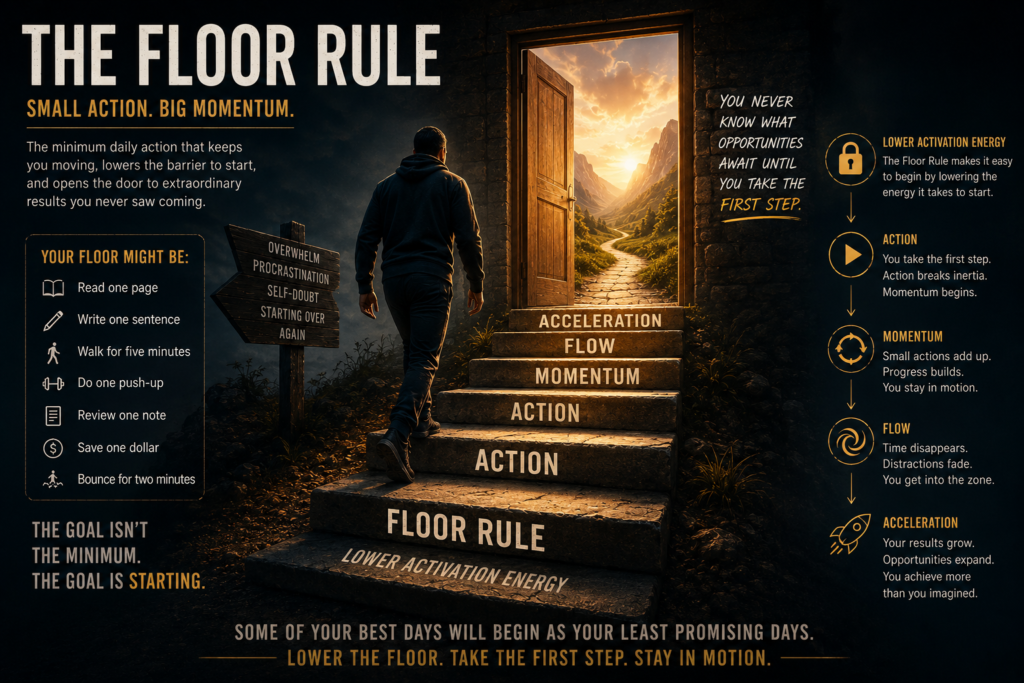
The Power Of The Floor Rule
The Momentum Mastery Principle That Makes Consistency Almost Automatic
Most people don’t fail because they lack information. Most people fail because they keep starting over.
They begin a new workout program. Miss a few days. Start again.
They begin a business project. Get busy. Stop. Start again.
They decide to study, write, save money, build a healthier lifestyle, or learn a new skill.
Then life happens. Energy drops. Motivation disappears. Momentum fades, then disappears completely. Now you feel the inertia…
Soon they find themselves back at the starting line wondering what went wrong. For years, I thought the solution was more discipline. Push harder. Work longer. Try to stay motivated. You know, “hustle culture”.
What I’ve discovered is that most people don’t need more motivation.
They need a lower floor. That’s where the Floor Rule comes in.
What Is The Floor Rule?
The Floor Rule is simple. Every goal should have a minimum daily action so small that it becomes difficult to fail. Not your ideal performance. Not your best day. Not what you would accomplish if everything went perfectly.
Just the smallest meaningful action that keeps you moving forward. I like to call it the “smallest viable action” that you will take that maintains and protects your momentum.
The key word here is “will”, as just because you can take an action, doesn’t mean you will. And that is an important distinction.
Examples:
- Read one page.
- Write one sentence.
- Walk for five minutes.
- Do one push-up.
- Review yesterday’s notes.
- Save one dollar.
- Bounce on the rebounder for two minutes.
At first glance, these actions seem almost too small to matter. That is exactly why they work.
The Floor Rule is not designed to impress people. It is designed to keep momentum alive.
Most People Focus on Ceilings
Think about how goals are usually created.
People set ambitious targets.
- Exercise for one hour.
- Write for ninety minutes.
- Study for three hours.
- Build the entire website.
- Finish the whole project.
There is nothing wrong with ambition.
The problem is that ambition often creates resistance. When the task feels too large, the brain begins negotiating.
“I’ll do it later.”
“I don’t have enough time.”
“I’m tired.”
“I’ll start tomorrow.”
Before long, tomorrow becomes next week. The Floor Rule changes the conversation.
Instead of asking:
“Can I do an hour?”
You ask:
“Can I do five or even two minutes?”
Most days the answer is yes. That small shift changes everything.
The Hidden Power of Never Returning to Zero
One of the core principles of Momentum Mastery is simple:
Never Return To Zero.
A missed day may seem harmless. But missed days can often become missed weeks. Missed weeks can become missed months.
Then people find themselves starting over again. The Floor Rule protects against this cycle.
Even on low-energy days, you can still complete your floor. You will complete your floor.
You can still move. You can still collect a win. You remain in motion. And motion matters. Because momentum is easier to maintain than it is to rebuild.
Why the Floor Rule Builds Self-Trust
Many people believe confidence comes first. In reality, confidence usually follows evidence.
Every time you complete your floor, you collect evidence. Evidence that you can follow through. Evidence that you can keep promises to yourself. Evidence that you can execute even when you don’t feel like it.
Over time, these small wins begin to change how you see yourself. You stop identifying as someone who starts, and stops. You begin identifying as someone who continues.
That shift is powerful. Because identity drives behavior.
The Science of Activation Energy
This is where the Floor Rule becomes even more interesting.
In chemistry, activation energy is the minimum amount of energy required to start a reaction.
Once the reaction begins, it often becomes self-sustaining.
Human behavior works much the same way. The hardest part of most tasks is not doing them. The hardest part is overcoming the force of inertia and beginning them.
Writing an article feels difficult. Writing one sentence feels manageable.
Studying for three hours feels overwhelming. Reading one page feels easy.
Running five miles feels intimidating. Putting on your shoes feels simple.
The Floor Rule lowers the activation energy required to start.
That is one of its greatest strengths. It helps you cross the threshold between thinking and doing.
And once you cross that threshold, something remarkable can happen.
Action Often Creates Energy
Most people believe the sequence works like this:
Energy → Action → Results
They wait until they feel motivated. They wait until they feel inspired. They wait until they feel ready. Unfortunately, that day often never arrives.
What many people discover is that the real sequence often looks like this:
Action → Energy → Results
You begin the walk. Then your energy improves.
You start writing. Then ideas begin flowing.
You begin exercising. Then motivation appears.
The action itself creates the energy.
The Floor Rule helps initiate that process. It gets you moving before you feel ready. That is powerful.
The Hidden Link Between the Floor Rule and Flow States
This may be the most overlooked benefit of all when you consistently apply the floor rule on messy, heavy, or low energy days.
Many people think flow is something that arrives before work begins. It isn’t. Flow often arrives after momentum has already started building.
Think about your own experience. How many times have you said:
“I’ll just do five minutes.” Then forty-five minutes later you’re still working?
Or:
“I’ll just write one paragraph.” Then an hour later you’ve written an entire article.
The Floor Rule wasn’t responsible for the extraordinary output. The Floor Rule simply opened the door. Flow walked through it.
This is why some of your most productive days may begin as your least promising days.
The day you almost skipped.
The day you felt tired.
The day you only committed to a tiny action.
If you never start, flow never gets a chance to find you. The Floor Rule creates opportunities for flow to emerge.
The Momentum Mastery Sequence
The process often looks like this:
Floor Rule
↓
Lower Activation Energy
↓
Action
↓
Momentum
↓
Flow
↓
Acceleration
Most people wait for flow.
Momentum builders create the conditions that make flow possible.
Real-World Examples
A writer commits to one sentence. A student commits to one page. An entrepreneur commits to ten minutes on a project. A person rebuilding their health commits to a five-minute walk. A rebounder commits to two minutes of bouncing.
The goal is not the minimum. The goal is starting. Once started, more often becomes possible.
Common Floor Rule Mistakes
The most common mistake is setting the floor too high.
A floor should feel easy. If you regularly miss it, lower it.
Another mistake is confusing the floor with the target. The floor is not your goal. The floor is your safety net.
Some days you’ll do far more. The floor simply guarantees progress continues on difficult days.
The 30-Day Floor Rule Challenge
Choose one goal.
Create a floor that feels almost laughably easy.
Then commit to it for thirty days.
Not perfectly. Consistently. Focus on maintaining motion, however small as needed. Focus on keeping promises to yourself. Focus on never returning to zero.
Observe… Observe what happens. Notice the change taking place.
You may discover that the smallest action was never really the point.
Final Thoughts
The Floor Rule is not designed to help you do more. It is designed to help you start.
Starting leads to action. Action creates momentum. Momentum opens the door to flow.
Flow can lead to extraordinary results.
Never underestimate what can happen after the five minutes.
Some of your best days may begin with the smallest commitment.
Lower the floor. Take the first step.
And let momentum do what momentum does best.
Learn more about Momentum Mastery here at MM52
Stay in Motion. Keep moving forward.
Al Smith
Momentum is the invisible force that transforms small actions into life-changing outcomes.
*Al Smith is the founder of TheSelfHelpLibrary.com and creator of Momentum Mastery, a practical system designed to help people stop starting over, build consistency, and create lasting positive change through simple daily actions.
For more than two decades, Al has studied personal development, success principles, habit formation, productivity, and human performance. His work focuses on helping people build momentum one small win at a time.