“Why does it feel like some people are playing life on ‘Easy Mode’ while you’re stuck pushing a boulder uphill?”
We’ve all seen them. The entrepreneurs who launch three businesses in a year. The athletes who never seem to miss a workout. The creators who produce content like clockwork.
We tell ourselves they have more willpower. We assume they were born with a ‘discipline gene’ that we missed out on.
But the truth is much less mysterious—and much more powerful. They aren’t stronger than you; they just have a different relationship with the laws of physics.
They aren’t working harder; they are simply in motion.
In the Success Habits Lab (TSHL), we don’t guess at what works. We look at the fundamental laws that govern progress. Let’s look at the science of why small actions create massive results…
The Physics of Momentum: Why Small Actions Create Massive Results
There is a silent force governing every result in your life right now. You can’t see it, but you can feel its weight.
When this force is against you, every morning feels like a battle. Every new project feels heavy. Every habit feels like a chore.
You feel like you’re constantly “starting over,” burning through your mental fuel just to get an inch of progress while others seem to be gliding by on “Easy Mode.”
But when this force is with you? Everything changes.
Hard tasks become automatic. Progress becomes effortless.
Success stops being something you “chase” and starts being something that pulls you forward.
This force is called Momentum, and once you learn to master it, you stop fighting the universe and start using its laws to carry you toward your goals.
1. The Science: Momentum = Mass × Velocity
In simple physics terms, momentum is the quantity of motion an object possesses. It is defined by a simple formula:
In your life and business, we can translate these variables into something practical:
* Mass (m): The “weight” or significance of your habits and systems.
* Velocity (v): The speed and direction of your consistent actions.
The physical truth is this: The more something is moving, the harder it becomes to stop it.
A tiny pebble rolling slowly has almost zero momentum; you can stop it with a finger.
But a freight train moving at full speed has massive momentum. Stopping that train instantly is impossible because its momentum has been building for miles.
The Lesson: You don’t need to start as a freight train. You just need to realize that every small action adds a fraction of velocity to your mass.
2. The Law of Inertia: Why Getting Started Is the Hardest Part
Closely related to momentum is Newton’s First Law of Motion: Objects at rest tend to stay at rest. Objects in motion tend to stay in motion.
This law explains the two most common human states:
Why We Stay Stuck
If you haven’t taken action in a while, inertia is working against you. Your brain prefers the status quo. Your habits keep you stationary. You remain “at rest” not because you lack talent, but because you haven’t applied enough force to break the initial friction.
Why Productive People Stay Productive
Once you start taking consistent action, the Law of Inertia flips. It begins working for you. Small wins create more action.
Action creates progress. Progress creates energy. Soon, you aren’t forcing yourself to work; you’re simply staying in motion.
3. The Power of “Micro-Moves”
Many people believe they must take massive, explosive action to change their life. But physics suggests something different.
Momentum doesn’t require a violent start; it simply requires uninterrupted movement.
Even a tiny push starts motion. Once motion begins, momentum follows.
The Snowball Effect
Think of a small snowball at the top of a hill.
* At first, it’s just a handful of snow.
* As it rolls, it gathers more mass.
* As it gathers mass, it gains velocity.
* Eventually, it becomes a force that can knock down trees.
Momentum works exactly the same way in your life. Small daily actions accumulate. Skills improve. Confidence grows. Progress accelerates.
Before long, what once felt like a “grind” becomes your natural state of being.
4. The Hidden Danger: Losing Your Velocity
Momentum is a double-edged sword. Just as motion builds progress, stopping motion kills momentum.
When you miss a few days of action, inertia begins creeping back in. This is why many people feel like they are “perpetual beginners.” They never protect their momentum long enough for it to compound.
In Momentum Mastery, we follow one cardinal rule to prevent this:
Never Return to Zero.
Even on your worst day, do something. Write one sentence. Do one pushup. Send one email.
Even the smallest action keeps the “train” moving so you don’t have to fight the heavy friction of starting over tomorrow.
5. How to Build Your Personal Momentum Engine
You don’t need dramatic life changes to create momentum. You only need consistent movement.
* Start Small: Choose a repeatable action so small it’s impossible to fail.
* Reduce Friction: Set your environment up so that the “first step” is easy.
* Prioritize the Streak: Focus more on not stopping than on how fast you’re going.
* Add Velocity: Once the habit is automatic, increase the intensity.
The TSHL Takeaway
Nature shows us a clear path:
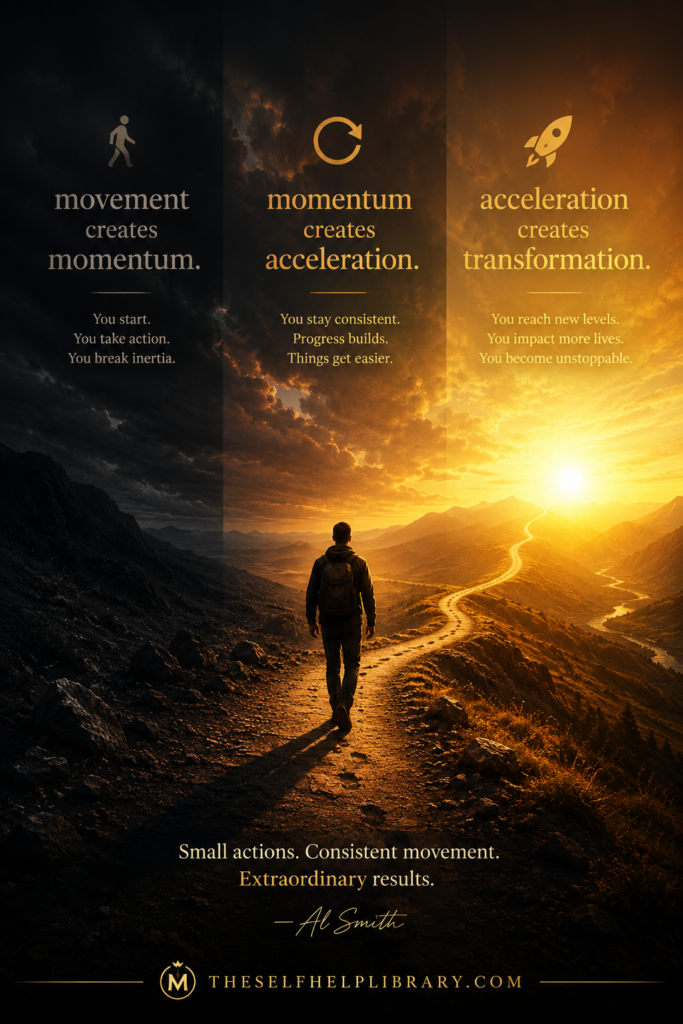
Movement creates Momentum.
Momentum creates Acceleration.
Acceleration creates Transformation.
The people who succeed consistently aren’t necessarily the most gifted. They are simply the ones who kept moving long enough for the laws of physics to take over the heavy lifting.
Your First Momentum Move
If you want to start building momentum today, don’t look at the mountain. Look at the pebble. Ask yourself:
What is one small action I can take right now—not tomorrow—that moves me forward?
Take that step. Then repeat it tomorrow. Once you’re in motion, you become a force of nature.
Stay in motion.
— Al Smith
Need a nudge?
If you aren’t sure where to start, try these prompts with your favorite AI assistant:
* Prompt 1: “Based on my current goal of [Insert Goal], what is one action so small I can’t fail at it today?”
* Prompt 2: “Help me identify the ‘friction points’ in my morning routine that are stopping my momentum.”
* Prompt 3: “I have 10 minutes. What is the most impactful ‘Micro-Move’ I can make for my business right now?”
Until next time: Stay in motion.
Al Smith
Momentum is the invisible force that transforms small actions into life-changing outcomes.
*Al Smith is the founder of TheSelfHelpLibrary.com and creator of Momentum Mastery, a practical system designed to help people stop starting over, build consistency, and create lasting positive change through simple daily actions.
For more than two decades, Al has studied personal development, success principles, habit formation, productivity, and human performance. His work focuses on helping people build momentum one small win at a time.
Learn more about Momentum Mastery here at MM52