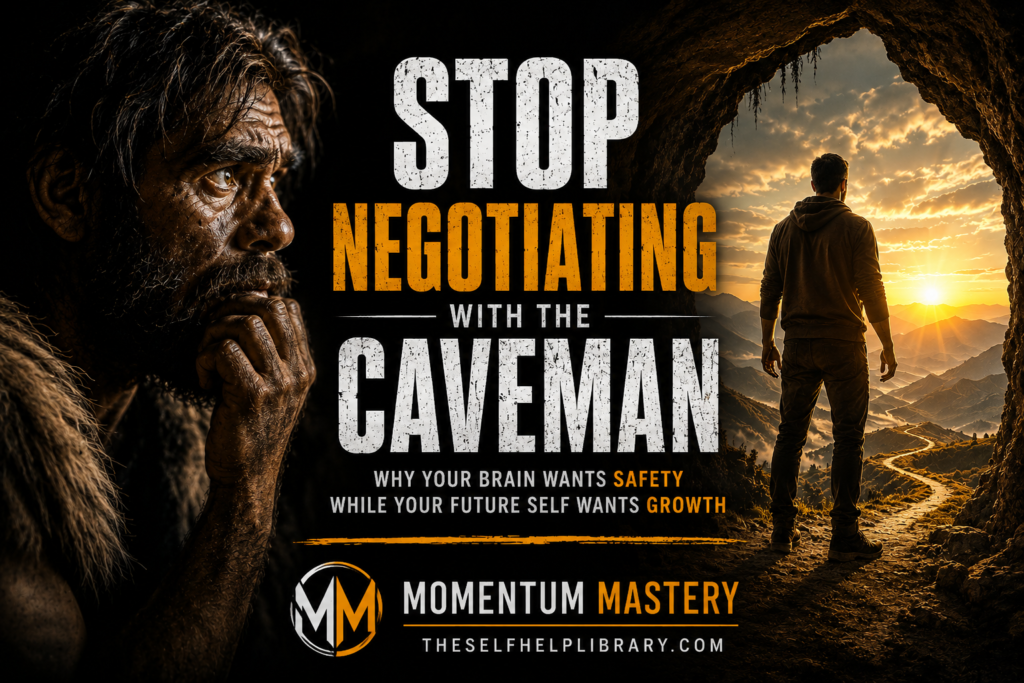
Stop Negotiating With The Caveman
Why Your Brain Wants Safety While Your Future Self Wants Growth
Have you ever noticed that the moment you decide to do something important, a strange voice appears in your head?
You decide to start a business.
The voice says, “What if it doesn’t work?”
You decide to go to the gym.
The voice says, “Maybe tomorrow.”
You decide to publish an article, start a YouTube channel, launch a product, make a sales call, or finally pursue a goal you’ve been putting off.
Suddenly, your mind fills with doubts, fears, excuses, and reasons to wait.
Most people assume this means something is wrong.
It doesn’t.
It means you’re human.
I recently came across an idea from marketer Perry Belcher that he calls the “Chicken Sh*t Caveman.”
While the name is humorous, the concept points to something very real.
Inside every one of us is an ancient survival system that evolved long before modern life existed. Its job is not to help you succeed.
Its job is to keep you alive.
And sometimes those two goals are in direct conflict.
The Brain Was Designed For Survival, Not Success
Thousands of years ago, survival depended on avoiding unnecessary risks.
Standing out could get you killed.
Leaving the tribe could get you killed.
Exploring unfamiliar territory could get you killed.
Playing it safe was often the smartest strategy available.
The cautious survived.
The reckless often didn’t.
The problem is that while the world has changed dramatically, much of our biological programming has not.
Today, the risks are different.
Nobody is being chased by a sabertooth tiger because they posted a video online.
Nobody starves because a sales call went badly.
Nobody dies because an article receives criticism.
Yet the brain often reacts as if these modern challenges are life-threatening events.
That’s why fear feels so real.
The survival system cannot always distinguish between physical danger and social discomfort.
To your ancient wiring, public criticism can feel surprisingly similar to physical danger.
Being rejected can feel like exile from the tribe.
Being visible can feel unsafe.
And so the caveman starts talking.
The Voice That Keeps You Small
The caveman rarely says:
“Don’t achieve your goals.”
He’s more subtle than that.
Instead, he says:
“You should do more research first.”
“Maybe wait until things calm down.”
“You need a better plan.”
“What if people laugh?”
“You can start next week.”
“Let’s think about this a little longer.”
The voice sounds logical.
Reasonable.
Even responsible.
But often it is simply fear disguised as strategy.
Many people spend years negotiating with this voice.
They wait until they feel confident.
They wait until they feel motivated.
They wait until fear disappears.
Unfortunately, that day rarely arrives.
The Great Lie About Confidence
One of the biggest myths in personal development is that confidence comes first.
People believe successful people take action because they are confident.
The truth is often the opposite.
Confidence usually arrives after action.
You publish the article.
Nothing terrible happens.
You survive.
You make the sales call.
You survive.
You attend the meeting.
You survive.
You launch the business.
You survive.
Over time, your brain begins collecting evidence.
The nervous system slowly learns that growth is not as dangerous as it originally believed.
Confidence is not the cause of action.
Confidence is often the result of repeated action.
That’s why waiting for confidence can become a trap.
Why Momentum Changes Everything
This is where Momentum Mastery becomes so powerful.
Momentum doesn’t require fear to disappear.
Momentum only requires movement.
The first action may feel uncomfortable.
The second action may still feel uncomfortable.
But something begins to happen as evidence accumulates.
The caveman starts losing credibility.
Every completed workout weakens the argument for skipping.
Every article published weakens the argument for procrastination.
Every promise kept strengthens self-trust.
Eventually, a shift occurs.
The activity that once felt difficult begins to feel normal.
What once felt risky becomes routine.
What once felt impossible becomes part of your identity.
The goal was never to defeat fear.
The goal was to build enough momentum that fear no longer gets to make decisions.
Fear Is Not Always The Enemy
It’s important to understand that fear itself is not bad.
Fear can be useful.
Fear can protect us from genuinely dangerous situations.
The challenge is learning the difference between danger and discomfort.
Most of the obstacles that stop people today are not life-threatening.
They are identity-threatening.
Fear of embarrassment.
Fear of failure.
Fear of judgment.
Fear of discovering that success may require more effort than expected.
These fears feel uncomfortable.
But discomfort is not danger.
Growth almost always requires stepping into uncertainty.
Stop Negotiating And Start Collecting Evidence
The caveman will probably never disappear completely.
Even successful people hear the voice.
The difference is that they stop treating it as an authority figure.
They recognize it for what it is:
An ancient survival mechanism trying to keep them safe.
Your future self wants something different.
Your future self wants growth.
Learning.
Progress.
Achievement.
Transformation.
Momentum is the bridge between safety and growth.
Every small action sends a message to your nervous system:
“See? We survived.”
Then you do it again.
And again.
And again.
Eventually, the evidence becomes undeniable.
You become the kind of person who takes action despite uncertainty.
The kind of person who keeps moving despite fear.
The kind of person who no longer negotiates with excuses.
Because you’ve learned a simple truth:
Fear may speak. But momentum gets the final vote.
Learn more about Momentum Mastery here at MM52
Stay in Motion. Keep moving forward.
Al Smith
Momentum is the invisible force that transforms small actions into life-changing outcomes.
*Al Smith is the founder of TheSelfHelpLibrary.com and creator of Momentum Mastery, a practical system designed to help people stop starting over, build consistency, and create lasting positive change through simple daily actions.
For more than two decades, Al has studied personal development, success principles, habit formation, productivity, and human performance. His work focuses on helping people build momentum one small win at a time.