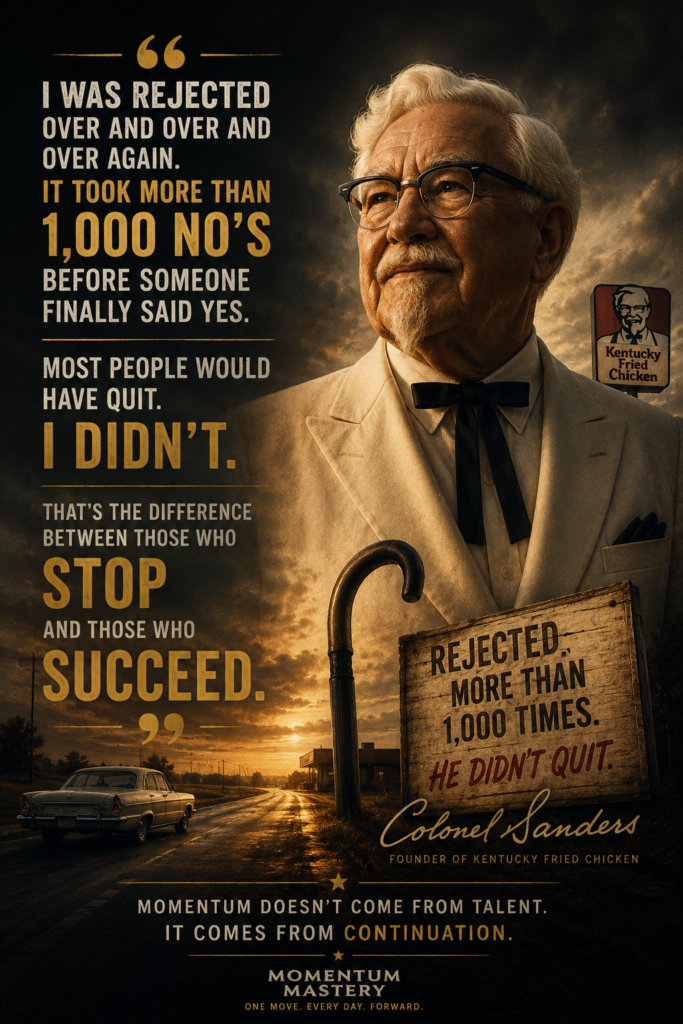
They Didn’t Quit
Rejected More Than 1,000 Times
Most people know Colonel Sanders as the smiling man on the bucket of fried chicken.
What many people don’t know is how close the world came to never hearing about him at all.
Before Kentucky Fried Chicken became a global brand, Sanders spent years struggling to make a living. He worked a variety of jobs throughout his life. Some worked out. Many didn’t.
Then, in his sixties, he found himself in a position that would cause many people to give up.
He wasn’t building an empire. He wasn’t becoming wealthy.
He was living on a small government pension check.
Most people would have accepted that their best years were behind them.
Colonel Sanders decided otherwise.
He believed he had something valuable to offer the world: his chicken recipe.
So he got in his car and began traveling from restaurant to restaurant trying to convince owners to use it.
And that’s when the real struggle began. One rejection. Then another. Then another.
Restaurant owners said no. Some weren’t interested. Some laughed. Some simply sent him away.
The exact number has become part of entrepreneurial folklore, but the lesson remains the same:
He was rejected hundreds upon hundreds of times before someone finally said yes.
Imagine what that must have felt like. Driving from town to town. Hearing no again and again. Watching doors close. Questioning yourself. Wondering if the effort was worth it.
Most people don’t need a thousand rejections to quit. Many quit after three. Some quit after one.
Colonel Sanders kept going. Not because he knew success was guaranteed. Not because he had proof it would work.
He kept going because he believed the next conversation might be different. Eventually, it was.
One restaurant owner agreed. Then another. Then another.
Momentum began to build.
What started as a single yes became multiple yeses. Those yeses became franchises. Those franchises became one of the most recognizable food brands in the world.
The lesson isn’t really about fried chicken. It’s about momentum.
People often look at successful individuals and focus on the result.
They see the restaurants. The wealth. The recognition.
They rarely see the years spent pushing forward when there was little evidence that success was coming.
Colonel Sanders didn’t become successful because he avoided rejection.
He became successful because rejection didn’t stop him. That’s an important distinction.
Momentum isn’t built when things are easy. Momentum is built when you continue moving despite resistance.
When most people stop, momentum stops with them.
When you keep moving, momentum has a chance to compound.
This is one of the core ideas behind Momentum Mastery.
You don’t need certainty. You don’t need perfect conditions. You don’t need everyone to believe in your vision.
You need to keep making the next move. One call. One conversation. One attempt. One more step forward.
Colonel Sanders didn’t know which conversation would change his life.
He simply refused to stop having conversations.
That’s the power of momentum.
It only needs one more chance.
Momentum Reflection
Where in your life have you been hearing “no” and assuming the answer is final?
What if it’s simply part of the process?
What if the next attempt is the one that changes everything?
Momentum Challenge
Make one move this week that you’ve been avoiding because of fear of rejection, failure, or disappointment.
One move. That’s all.
Momentum doesn’t ask for certainty. It asks for continuation.
And Colonel Sanders is proof of what can happen when you refuse to quit.
Learn more about Momentum Mastery here at MM52
Stay in Motion. Keep moving forward.
Al Smith
Momentum is the invisible force that transforms small actions into life-changing outcomes.
*Al Smith is the founder of TheSelfHelpLibrary.com and creator of Momentum Mastery, a practical system designed to help people stop starting over, build consistency, and create lasting positive change through simple daily actions.
For more than two decades, Al has studied personal development, success principles, habit formation, productivity, and human performance. His work focuses on helping people build momentum one small win at a time.