 Why Cognitive Load Destroys Momentum, Focus, and Consistency
Most people think clutter is a housekeeping problem.
It isn’t.
Clutter is a momentum problem.
Every object you own, every unfinished task, every open browser tab, every messy drawer, every unresolved decision, every “I’ll deal with that later” pile in your life quietly asks for attention.
Not loudly.
Not all at once.
But constantly.
And that constant background demand creates cognitive load.
Cognitive load is the invisible weight your mind carries while trying to think, decide, focus, create, and take action.
The problem is simple:
The more mental weight you carry, the harder it becomes to move.
And when movement becomes hard, momentum dies.
1. What Clutter Really Costs You
Clutter does not just take up space.
It takes up attention.
That pile of papers on your desk is not just paper.
It is a reminder.
That closet full of clothes you never wear is not just clothing.
It is a decision field.
That unfinished project sitting in the corner is not just a project.
It is an open loop.
That cluttered desktop on your computer is not just a messy screen.
It is visual noise before the real work even begins.
And the more open loops you carry, the more your brain has to process before you can focus on what actually matters.
This is why clutter feels heavier than it looks.
It creates invisible friction.
And friction is the enemy of Momentum.
2. Why Cognitive Load Destroys Momentum
Cognitive load is the amount of mental demand placed on your working memory.
Your brain can only hold and process so much at once.
When your environment is overloaded, your attention gets split into too many directions.
You may still function.
You may still get through the day.
But deep focus becomes harder.
Simple decisions feel heavier.
Starting important work takes longer.
Finishing becomes less likely.
And eventually, you mistake mental overload for personal weakness.
You say:
“I’m lazy.”
“I’m unmotivated.”
“I have no discipline.”
“I can’t stay consistent.”
But often, the real issue is this:
Your life has too much friction for momentum to survive.
3. The Real Problem Is Not Stuff — It Is Attention
The goal is not to own nothing.
The goal is to stop letting everything own your attention.
This is the key distinction.
Momentum Mastery is not about becoming a monk.
It is not about removing every comfort from your life.
It is not about living with one chair, one shirt, and one bowl.
It is about asking a better question:
Does this thing support the life I am building, or does it quietly compete with it?
Some possessions support momentum.
A clean desk can support writing.
A good pair of walking shoes can support health.
A notebook can support clarity.
A simple workspace can support deep work.
But other things become attention leaks.
They need organizing.
They need fixing.
They need charging.
They need returning.
They need storing.
They need explaining.
They need deciding.
They need emotional energy.
This is the hidden cost of clutter.
It is not the object.
It is the attention attached to the object.
4. How Clutter Creates the Restart Trap
The Restart Trap begins when your environment keeps pulling you away from your next meaningful action.
You intend to work.
But first, you clean the desk.
Then you find an old bill.
Then you remember an email.
Then you open your phone.
Then you check a notification.
Then you lose the thread.
Now the original action feels farther away.
This is how clutter breaks momentum.
Not dramatically.
Subtly.
One micro-distraction at a time.
And when this happens often enough, you begin to believe you are the problem.
But you may not need more motivation.
You may need less noise.
Less friction.
Less stuff in the way.
Less decision fatigue.
Less visual chaos.
Less emotional residue.
Less unfinished business.
Momentum grows when the next right action becomes obvious.
Clutter makes the next right action harder to see.
5. Physical Clutter, Digital Clutter, and Emotional Clutter
Clutter comes in several forms.
Physical Clutter
This includes:
- messy desks
- overloaded closets
- random piles
- drawers full of unknown items
- unfinished home projects
- tools, gadgets, and supplies you no longer use
Physical clutter creates visual noise.
It constantly reminds your brain that something is unresolved.
Digital Clutter
This includes:
- too many browser tabs
- overflowing inboxes
- scattered documents
- unused apps
- phone notifications
- messy desktops
- too many subscriptions
Digital clutter may be even more dangerous because it follows you everywhere.
It lives in your pocket.
Emotional Clutter
This includes:
- unfinished conversations
- vague commitments
- guilt-based obligations
- old goals you never officially released
- decisions you keep postponing
- identities you have outgrown
This is often the heaviest clutter of all.
Because emotional clutter does not just fill your space.
It fills your inner world.
And when your inner world is overloaded, momentum becomes harder to build.
6. The Momentum Friction Framework
Here is the simple Momentum Mastery framework:
Clutter Creates Load
Every unresolved object, task, decision, and commitment adds mental weight.
Load Creates Friction
The more your brain has to process, the harder it becomes to begin.
Friction Blocks Action
When starting feels heavy, you delay.
Delay Breaks Momentum
The longer you delay, the more likely you are to restart from zero.
Reduction Restores Movement
When you remove friction, action becomes easier.
And when action becomes easier, momentum returns.
This gives us a simple equation:
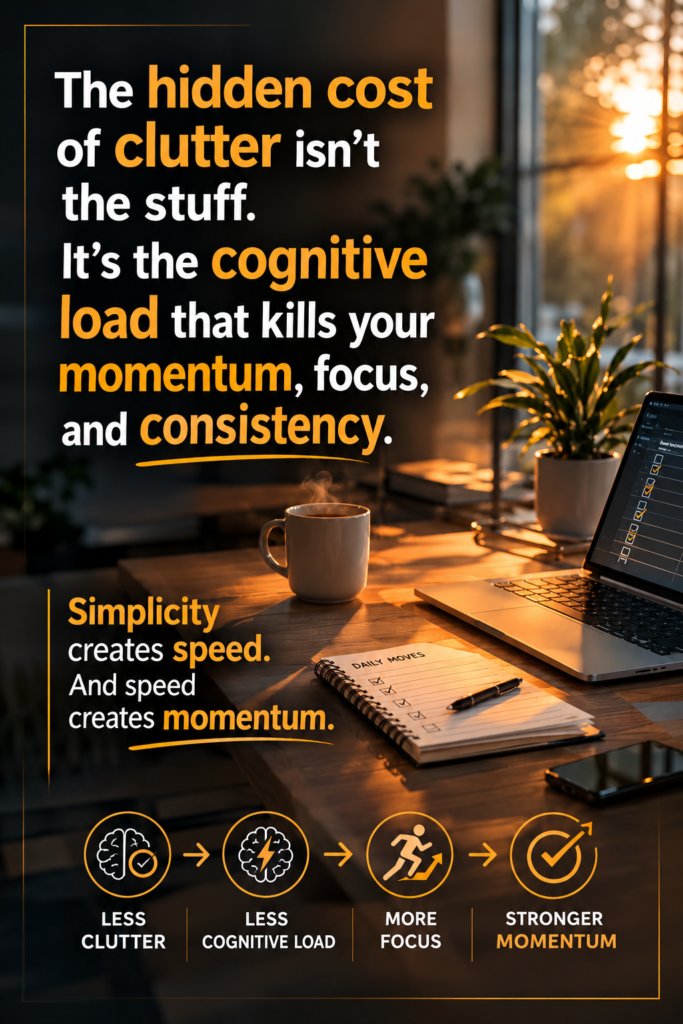
Less clutter → less cognitive load → less friction → more action → stronger momentum.
7. How to Reduce Clutter Without Becoming a Minimalist
You do not need to become extreme.
You need to become intentional.
The question is not:
“How little can I own?”
The better question is:
“What deserves access to my attention?”
Start with these filters:
1. Does this support my current life?
Not who you used to be.
Not who you imagined becoming ten years ago.
Your current life.
Your current goals.
Your current direction.
2. Does this make action easier or harder?
Some things create momentum.
Some things create drag.
Be honest.
3. Would I choose this again today?
If the answer is no, it may be clutter.
4. Is this an open loop?
If it constantly reminds you of guilt, confusion, unfinished business, or delay, it is costing you more than space.
5. Is this worth the attention it requires?
That is the master question.
Because every possession, task, project, and commitment has a cost of ownership.
Sometimes the cost is money.
Often, the greater cost is mental energy.
8. The Daily Moves Environment
The best environment is not the prettiest environment.
It is the one that makes your next good action easier.
A Daily Moves Environment is designed around momentum.
It helps you do the right thing with less resistance.
That might mean:
- walking shoes by the door
- a clean writing space
- a visible notebook
- fewer phone notifications
- a prepared morning routine
- a simple meal plan
- one priority list
- fewer active projects
- a clear desk before bed
- a shutdown ritual at the end of the day
Momentum is not just built through willpower.
It is built through design.
When your environment supports your next action, discipline becomes less necessary.
You are no longer fighting your surroundings.
Your surroundings are helping you move.
9. The 7-Day Momentum Declutter Reset
Here is a simple starting point.
Day 1: Clear One Surface
Desk. Table. Counter. Nightstand.
One surface only.
Create one visible win.
Day 2: Remove One Decision Zone
Simplify one area that creates daily decision fatigue.
Clothes. Meals. Work tools. Morning routine.
Day 3: Clean Your Digital Start Point
Clear your desktop.
Close unused tabs.
Delete distracting apps.
Turn off unnecessary notifications.
Day 4: Release One Dead Project
Choose one project you are no longer committed to.
Officially release it.
This frees emotional energy.
Day 5: Build One Action Station
Create a ready-to-use setup for one important Daily Move.
Writing station.
Workout station.
Reading chair.
Planning area.
Day 6: Create a Friction List
Write down everything that makes your important actions harder.
Then remove one friction point.
Day 7: Install a Maintenance Rule
Use this rule:
Before I add more, I remove what no longer serves.
That single rule can protect your momentum for years.
10. Final Thought: Simplicity Creates Speed
Clutter slows you down.
Not because you are weak.
Not because you lack ambition.
Not because you are lazy.
But because your attention is finite.
Your focus is finite.
Your energy is finite.
Your decision-making power is finite.
And if too much of that power is being spent managing noise, there will be less available for building the life you actually want.
Momentum requires movement.
Movement requires clarity.
Clarity requires space.
So maybe the next level of your life does not begin by adding more.
Maybe it begins by removing what keeps pulling you away.
Less noise.
Less friction.
Less unfinished business.
Less cognitive load.
More focus.
More action.
More momentum.
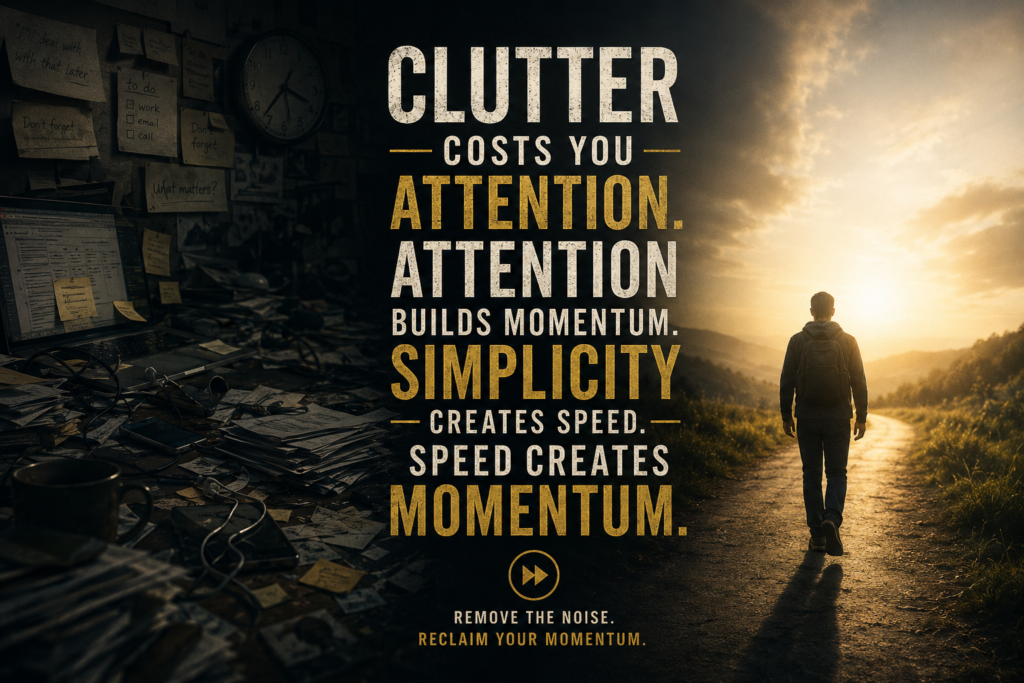
Simplicity creates speed.
And speed creates momentum.
Daily Moves AI Assist
Use this prompt with your favorite AI tool:
I want to reduce clutter and cognitive load so I can build more momentum in my life. Help me identify the physical, digital, and emotional clutter that may be creating friction. Ask me questions one at a time, then help me design a simple 7-day Momentum Declutter Reset based on my current goals.
Al Smith
Al Smith is the founder of TheSelfHelpLibrary.com and creator of Momentum Mastery, a practical system designed to help people stop starting over, build consistency, and create lasting positive change through simple daily actions.
For more than two decades, Al has studied personal development, success principles, habit formation, productivity, and human performance. His work focuses on helping people build momentum one small win at a time.
Learn more about Momentum Mastery at TheSelfHelpLibrary.com