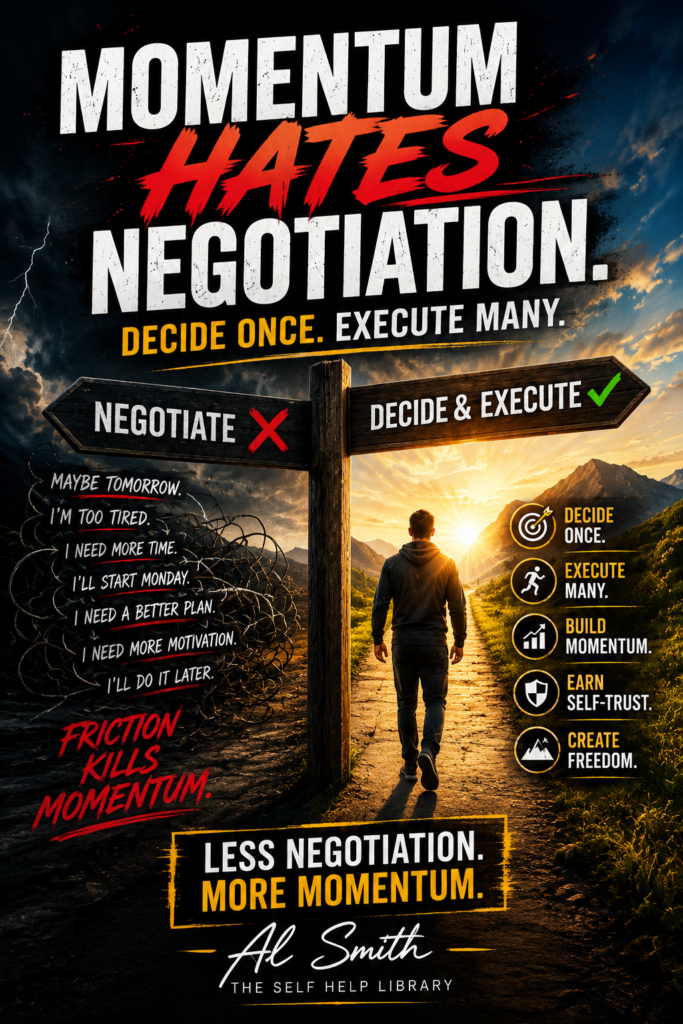
Momentum Hates Negotiation
Why Successful People Decide Once and Execute Many Times
The other day I caught myself doing something I’ve done thousands of times before.
I was standing in the kitchen, coffee in hand, thinking about a task I had already decided to do.
It wasn’t a difficult task. It wasn’t dangerous. It wasn’t complicated.
In fact, it would probably only take fifteen or twenty minutes.
Yet there I was, having a conversation with myself about whether I should do it.
Maybe later. Maybe after lunch. Maybe tomorrow. Maybe when I have more energy. Maybe when I feel more motivated.
As I listened to the debate unfolding in my own mind, a thought occurred to me. The task wasn’t the problem. The negotiation was. And that’s when a phrase came to me:
Momentum hates negotiation.
The more I thought about it, the more I realized how often this happens. Not just to me. To almost everyone.
The Hidden Cost of Negotiation
Many people believe their biggest challenge is motivation.
But often motivation isn’t the real issue. The real issue is that they keep renegotiating commitments they have already made.
Should I work out today?
Should I write today?
Should I make the sales call?
Should I stick to the budget?
Should I go for the walk?
Should I start tomorrow instead?
Every one of these questions creates friction. Every debate consumes energy. Every negotiation delays action.
By the time the discussion is over, the energy needed to execute has often been spent.
The task itself may only require fifteen minutes. The negotiation may consume an hour.
Why Momentum Loves Simplicity
Think about brushing your teeth. You probably don’t stand in front of the mirror every morning asking yourself:
“Should I really do this today?”
The decision was made years ago. There is no debate. There is no vote. There is no motivational speech. You simply execute.
This is one of the hidden secrets behind consistency.
People who appear highly disciplined are often people who have simply eliminated unnecessary decisions.
They don’t spend energy deciding. They spend energy doing. The action has already been approved.
The Start-Stop Cycle Begins With Negotiation
One thing I’ve noticed over the years is that almost every restart begins with a negotiation.
Nobody wakes up one morning and decides to abandon their goals forever. It usually starts much smaller.
Maybe I’ll skip today. Maybe I’ll restart Monday. Maybe I’ll wait until things calm down. Maybe I’ll begin again next month.
The first negotiation seems harmless. But negotiations have a way of multiplying. One skipped day becomes three. Three becomes a week. A week becomes a month.
Soon you’re back at the starting line wondering what happened.
The goal wasn’t destroyed by failure. It was slowly negotiated away.
Why The Floor Rule Works So Well
This is one of the reasons the Floor Rule is such a powerful Momentum Mastery principle.
The Floor Rule removes negotiation.
You don’t ask whether you’re going to do the habit. You only decide which version you’re doing today.
A full workout. A short workout. Or the absolute minimum version. The decision to continue has already been made.
Only the size changes. This simple shift eliminates a tremendous amount of internal friction. And friction is one of momentum’s greatest enemies.
Every Negotiation Weakens Self-Trust
There is another hidden cost to constant negotiation. Self-trust.
Every time you make a promise to yourself and immediately begin arguing with that promise, you weaken confidence in your own word.
Over time, your brain starts noticing. You say you’ll do something. Then you debate it. Delay it. Modify it. Postpone it.
Eventually your mind stops taking your commitments seriously.
Not because you’re incapable. Because you’ve trained yourself to treat every commitment as optional.
Self-trust grows when your actions become predictable. You decide. Then you execute. You decide. Then you execute.
Over time, confidence naturally follows.
Decide Once. Execute Many.
One of the biggest differences between people who build momentum and people who stay stuck is not intelligence, talent, or willpower.
It’s the number of negotiations they allow into the system.
Successful people often make fewer decisions because important decisions were already made.
The workout was decided yesterday. The writing session was scheduled last week. The walk happens after dinner. The habit has a place. The decision has already been settled.
Instead of spending energy debating, they spend energy moving.
That’s why routines work. That’s why habits work. That’s why systems work. They eliminate negotiation.
And when negotiation disappears, momentum has room to grow.
One Rule To Remember
If you remember nothing else, remember this:
Every negotiation creates friction.
Every debate consumes energy.
Every “maybe” delays momentum.
The goal is not to become more motivated. The goal is to move more actions from the category of daily debate into the category of automatic execution.
Decide once. Execute many.
That’s how momentum is built.
Reflection Question
What commitment in your life are you still renegotiating every day?
And what would happen if you made the decision once and stopped arguing with yourself?
Learn more about Momentum Mastery here at MM52
Stay in Motion. Keep moving forward.
Al Smith
Momentum is the invisible force that transforms small actions into life-changing outcomes.
*Al Smith is the founder of TheSelfHelpLibrary.com and creator of Momentum Mastery, a practical system designed to help people stop starting over, build consistency, and create lasting positive change through simple daily actions.
For more than two decades, Al has studied personal development, success principles, habit formation, productivity, and human performance. His work focuses on helping people build momentum one small win at a time.