The Hidden Scorecard of Aging
Why Recovery Might Matter More Than Your Birth Certificate
In a few days, I turn 75. That number surprises me sometimes.
Not because I think I’m young, but because I don’t feel like the version of 75 that many people expect.
I’m not running marathons. I’m not trying to prove anything. I’m not chasing some fantasy of eternal youth.
What I am doing is paying attention.
I’ve spent years observing how my body responds to movement, sunlight, stress, recovery, food, sleep, purpose, and daily habits.
And over time, I’ve come to believe something that may be more important than almost any anti-aging strategy you’ll ever hear.
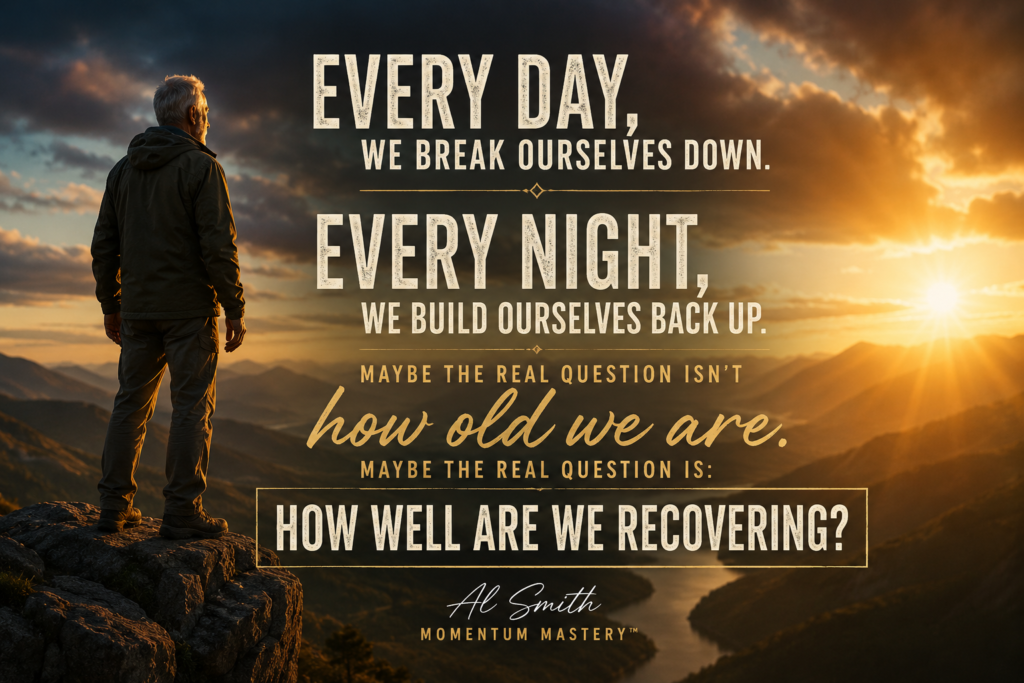
Every day, we break ourselves down. Every night, we build ourselves back up.
Maybe the real question isn’t how old we are. Maybe the real question is:
How well are we recovering?
Life Is a Daily Cycle of Stress and Recovery
The human body was built to adapt.
Walk long enough and your endurance improves. Lift weights and your muscles become stronger. Practice balance and your stability increases. Challenge your mind and your thinking sharpens.
This is how life works.
The body responds to demand. The mind responds to challenge. The problem isn’t stress. The problem is when recovery falls behind stress.
Every day creates wear and tear.
Physical activity. Mental effort. Work responsibilities. Emotional challenges. Environmental stressors. Even living itself requires energy.
Throughout the day, things are constantly breaking down.
Then night arrives. The body begins repairing. The brain processes information. Hormones rebalance. Cells rebuild. Energy systems recharge.
Recovery begins.
When recovery keeps pace with stress, adaptation happens. When recovery falls behind, deterioration begins.
The Hidden Scorecard Nobody Sees
Most people track the wrong numbers.
They track age. They track weight. They track income. They track accomplishments.
But there may be a more important scorecard operating behind the scenes.
Recovery capacity.
How quickly do you bounce back from challenges?
How quickly do you recover from setbacks?
How quickly do you regain momentum after interruptions?
How resilient are your systems?
Because resilience affects everything.
Your health. Your confidence. Your relationships. Your business. Your ability to pursue goals. Your ability to enjoy life.
A highly resilient person can handle enormous challenges. A depleted person can be overwhelmed by small ones.
The difference is often not strength.
It’s recovery.
Momentum Works the Same Way
One of the biggest lessons I’ve learned through developing Momentum Mastery is that momentum itself depends on recovery.
People often assume they fail because they lack discipline.
Sometimes that’s true.
But many times, the real problem is that they’re carrying too much recovery debt.
They’ve been pushing for months. Maybe years. Without replenishing their reserves.
Eventually the system starts sending signals. Procrastination. Brain fog. Low motivation. Lack of focus. Inconsistency. Starting over.
Not because they suddenly became lazy. Because recovery has fallen behind demand.
Momentum isn’t built by pushing endlessly. Momentum is built by cycling challenge and recovery effectively.
Just like training a muscle.
The Body Adapts When You Give It a Reason
This idea has fascinated me for decades.
The body doesn’t adapt because we wish it would. It adapts because we give it a reason.
Muscles adapt to resistance. Bones adapt to loading. Balance adapts to practice. Endurance adapts to movement.
The body continually asks:
“What do I need to become better at?”
Then it starts making adjustments.
That process doesn’t stop at a particular birthday.
It may slow. It may require more patience.
But the ability to adapt remains remarkably resilient.
The body is always listening.
The question is:
What message are we sending it?
The Goal Is Not to Stop Aging
I think this is where many people get confused.
They want to stop aging. That’s not the goal. The goal is to stay capable. To stay adaptable. To stay engaged. To maintain the ability to do the things that matter.
Aging happens.
The calendar keeps moving. None of us get a vote on that. What we do get a vote on is how we respond.
We can move. We can challenge ourselves. We can recover. We can remain curious. We can continue learning. We can continue building. We can continue adapting.
That is where the opportunity lives.
A Different Way to Think About Longevity
I don’t know how many years I have left. Nobody does.
But I’ve become convinced that longevity is not simply about accumulating more years. It’s about maintaining the capacity to live those years well.
The goal isn’t to avoid every stressor. The goal is to build enough resilience to recover from them.
Life will always contain challenges. There will always be setbacks. There will always be demands.
The answer isn’t to hide from them. The answer is to recover well enough to face them again tomorrow.
And then the day after that. And the day after that.
Maybe the hidden scorecard of aging isn’t the number of candles on the cake.
Maybe it’s the balance between stress and recovery. The balance between breakdown and rebuilding. The balance between challenge and adaptation.
Every day, life asks something of us.
And, every night, recovery gives us a chance to answer again.
Protect your recovery. Support your resilience. Give your body and mind reasons to adapt.
Then keep showing up. Because momentum isn’t just how we reach goals. It’s how we stay in the game.
Momentum Challenge:
Today, ask yourself one simple question:
“Am I recovering as intentionally as I’m working?”
Your answer may reveal more about your future than your age ever will.
Keep moving forward,
Al Smith
Momentum is the invisible force that transforms small actions into life-changing outcomes.
*Al Smith is the founder of TheSelfHelpLibrary.com and creator of Momentum Mastery, a practical system designed to help people stop starting over, build consistency, and create lasting positive change through simple daily actions.
For more than two decades, Al has studied personal development, success principles, habit formation, productivity, and human performance. His work focuses on helping people build momentum one small win at a time.
Learn more about Momentum Mastery here at MM52